Near Pringle, a Listing That Says “Live Water” Is Making a Promise the Deed Might Not Keep
September 17, 2026
September 17, 2026
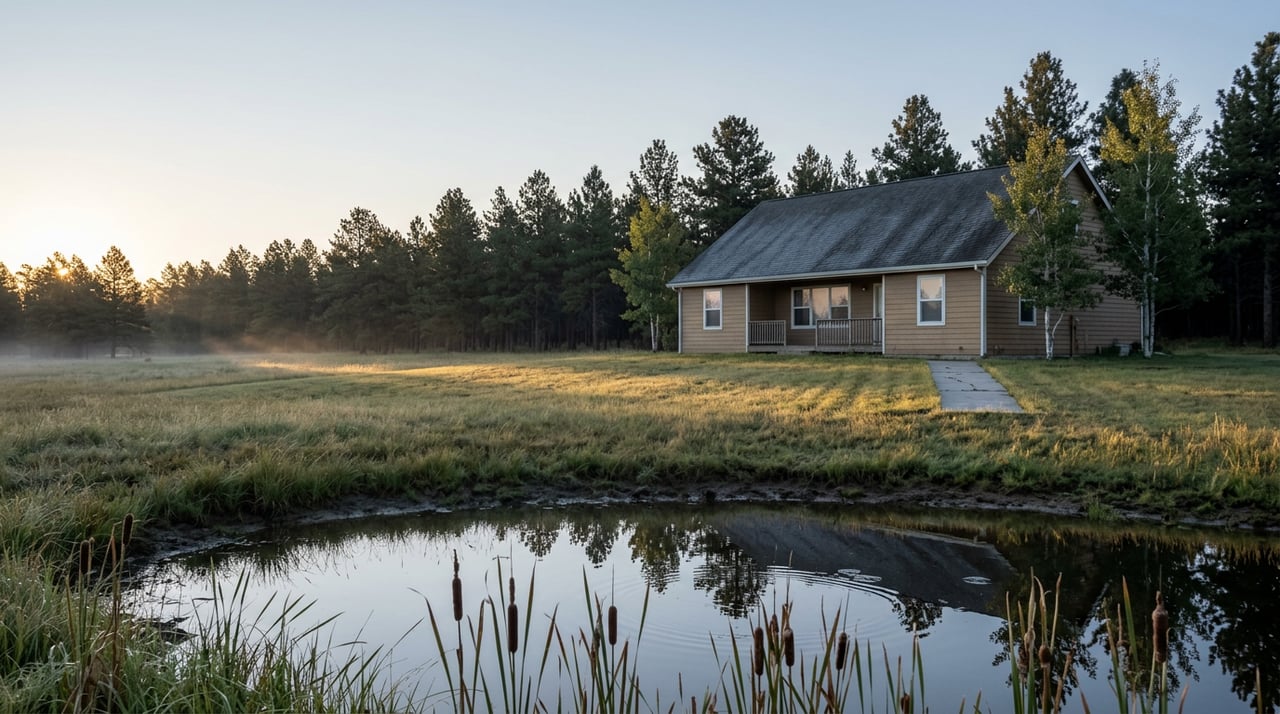
Scroll through acreage listings south of Pringle long enough and you start to notice a pattern in the language. One recent parcel description leaned hard on the amenities: live water, trout fishing beaver ponds, a boundary against national forest land, mountain views, no covenants. It read like a checklist for exactly the kind of buyer who wants Black Hills land to feel wild and unmanaged. What it didn't spell out was what water use, if any, you could count on.
That gap between what a listing implies and what a South Dakota deed actually conveys is the thing buyers looking at Pringle-area acreage run into late, usually during due diligence, sometimes not until after closing. It's worth understanding before you write an offer, not after.
South Dakota treats water differently than most buyers expect coming from other states. Under South Dakota's Water Rights program, all water within South Dakota, both surface water and groundwater, is the property of the people of the state, not the landowner sitting above or beside it. What you can actually acquire is the right to use that water, and that right is administered through South Dakota's water rights program under the Doctrine of Prior Appropriation, which South Dakota's water-rights summary describes as a system where the first person to file for a given water use generally holds priority over anyone who files later.
That single distinction changes what "land with a creek" or "land with a well" actually means on paper. The water-rights file is worth reviewing for a property beside Lame Johnny Creek or a beaver pond.
Under South Dakota's Water Rights program, domestic use is exempt from a water right permit. The category includes drinking, washing, sanitary and culinary uses by a household, plus irrigation of a noncommercial garden under an acre, stock watering, and modest recreational uses. As long as total use stays under 25,920 gallons per day or a peak pump rate of 25 gallons per minute, no separate water right permit is required.
That threshold covers a typical household comfortably. It does not cover much of a working ranch. A cow-calf operation watering a meaningful herd, or a buyer planning to irrigate hay ground, can cross that line faster than the acreage listing's photos would suggest, at which point the state's prior appropriation rules kick in fully, including the possibility that a nearby senior water right holder has priority over you in a dry year.
There's a version of this that cuts the other way too. A property advertised with an existing well can look like it saved the buyer a step, when in some cases it hands them a liability instead.
South Dakota's well construction rules put real weight behind the word "adequate." The state defines an adversely impacted domestic well with startling specificity:
An adversely impacted domestic well is a well in which the pump intake is at least 20 feet below the top of the aquifer, or as near to the bottom as practical if the aquifer is less than 20 feet thick, and the water level has declined to where the pump can no longer deliver sufficient water.
And if a well on the property is abandoned rather than actively used, South Dakota's Water Rights program makes the current property owner responsible for plugging it, regardless of who drilled it or when. That's a cost that shows up after closing, not before, unless someone asks the question during due diligence.
South Dakota's Water Rights program requires anyone drilling new to hire a driller licensed by the state, and its well-drilling guidance says that, since the 1989 Centennial Environmental Protection Act, every new domestic well requires a water sample submitted to the state health lab before it's considered complete.
The Pringle land market includes everything from small platted lots in newer subdivisions to vacant quarter-sections to multi-hundred-acre ranches bordering the national forest, and the water situation looks different on each type. A short list of what to actually verify, matched to what's typically for sale in this area:
None of this is a reason to avoid Pringle-area land. It's the reason to slow down enough to read the water rights file the way you'd read a title report, because in South Dakota, that file is doing a lot of the same work.
A listing that promises live water, forest access, and grazing capacity is describing what the land looks like. What you actually own is defined by a separate, quieter set of state records, and the gap between those two things is exactly where a good closing goes sideways or a bad one gets caught in time.
That's the kind of gap a fourth-generation local eye is built to catch. If you're looking at acreage or a ranch near Pringle and want someone who reads the water rights file as carefully as the listing photos, Amanda Carlin has spent a career in this exact ground.
Does an existing well on the property guarantee I have the water rights to use it? Not automatically. Domestic use up to 25,920 gallons per day or 25 gallons per minute doesn't require a separate permit, but uses beyond the stated domestic-use exemption may require a separate filing under South Dakota's Doctrine of Prior Appropriation.
If a ranch listing includes a Forest Service grazing permit, does it transfer with the sale? Buyers should get written confirmation from the Forest Service rather than assuming the acreage total on the listing reflects deeded land.
Who is responsible for an old, unused well on a property I just bought? The current owner. South Dakota law makes whoever owns the property where an abandoned well sits responsible for plugging it, regardless of who drilled the well originally.
This article is general information, not legal, tax or financial advice. Consult a qualified professional about your situation.


Our deep local expertise and commitment to our clients ensure a smooth and informed real estate journey. We're here to guide you every step of the way, sharing insider knowledge on the best neighborhoods, schools and local gems.